

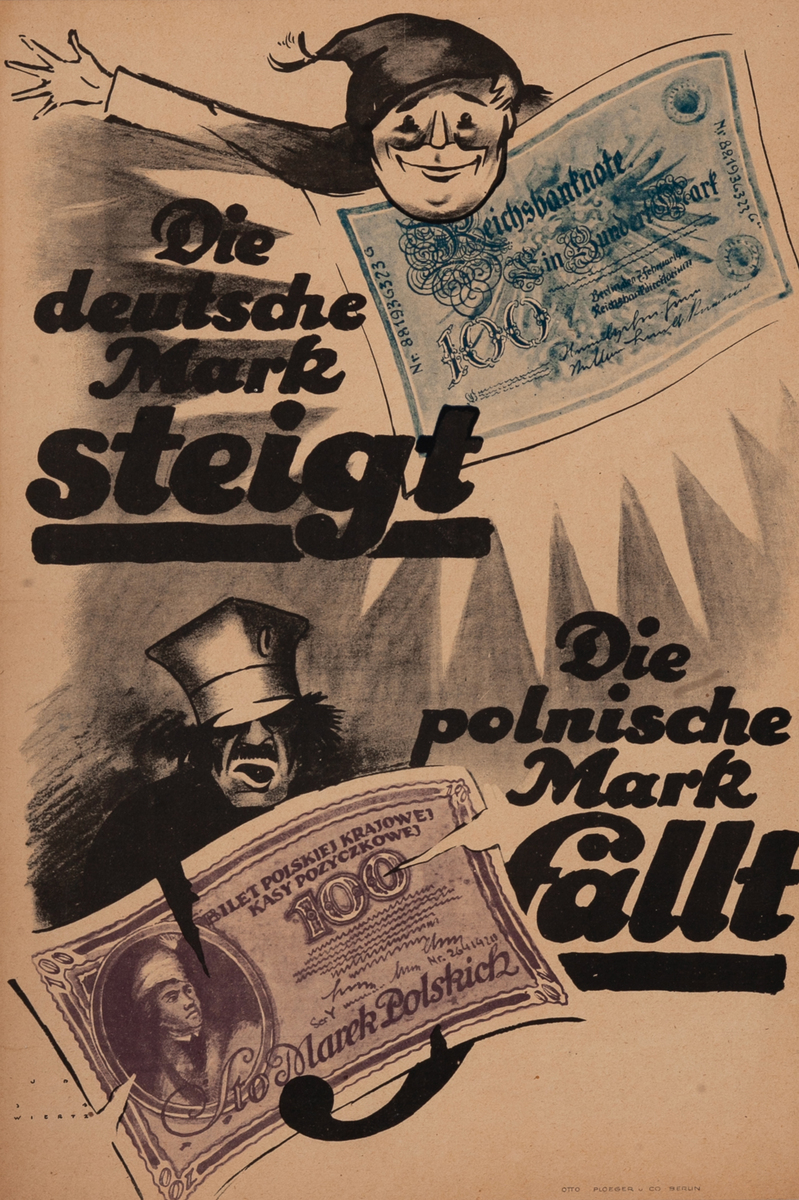
The German Mark is Rising - The Polish Mark is Falling Poster WWI Propaganda Poster
- ca 1920s
- Jupp Wiertz (Joseph Lambert Wiertz, 1888–1939)
-
12 x 18 inches ~ (30 x 45 cm)$450
- Linen backed
Linen backing is the industry standard of conservation. Canvas is stretchered and a sheet of acid free barrier paper is laid down. The poster is then pasted to the acid free paper using an acid free paste. This process is fully reversible and gives support to the poster. A border of linen is left around the poster and can be used by a framer to mount the poster so that nothing touches the poster itself.
The price of this poster includes linen backing.
- Add to Cart Add to Wishlist E-Mail Us About This Poster
Die deutsche Mark steigt (The German Mark is rising) An upbeat, cheerful German lifting a 100-Mark Reichsbanknote. compared to a Die polnische Mark fällt" (The Polish Mark is falling) with a grim, caricatured figure leaning over a dropping 100-Mark Polish loan-fund banknote.
Following World War I and the resurgence of the Polish state, Germany and Poland fiercely contested the industrial region of Upper Silesia. The poster was used during nationalist and economic campaigns in the early 1920s to sway local populations and public opinion by weaponizing currency values and portraying the German economy as ascendant while mocking Polish currency.
OTTO PLÖTZ - Ch. BERLIN"
