

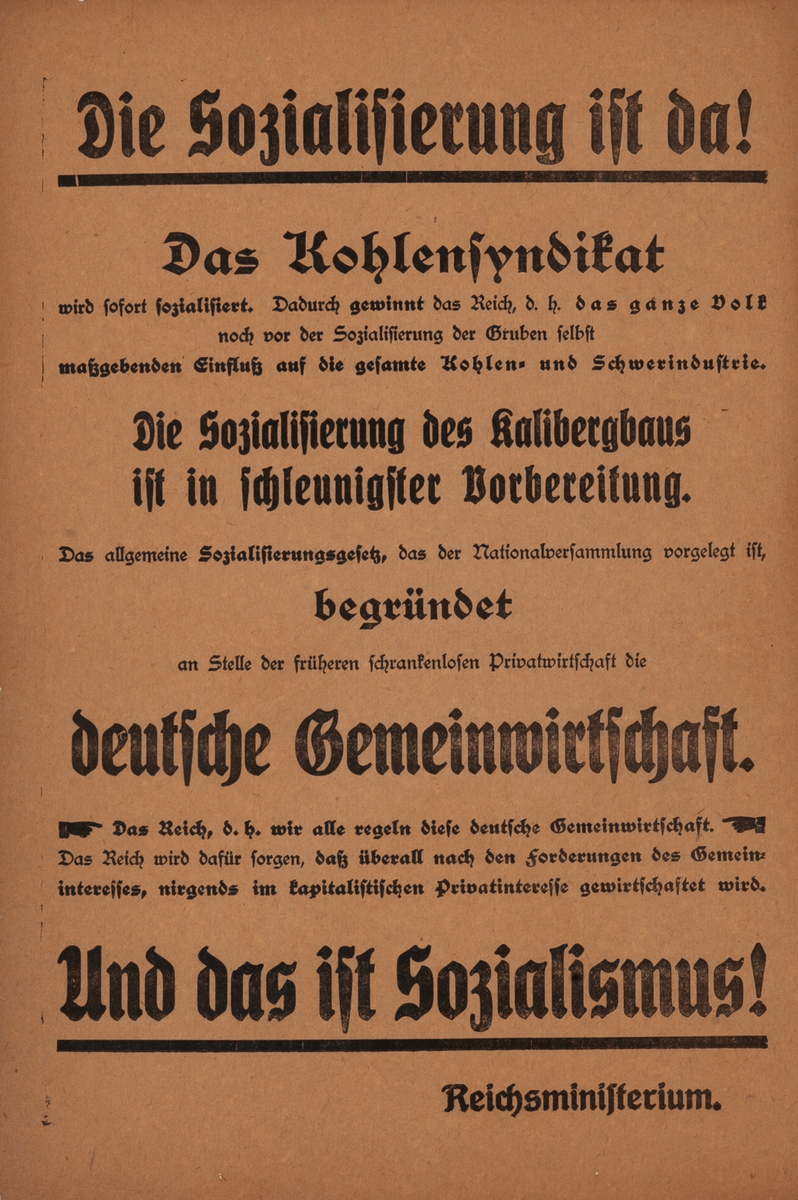
Die Sozialisierung ist da! Socialization is here! post-WWI German Propaganda Poster
- ca 1920
-
12 x 18 1/2 inches ~ (30 x 45 cm)$165
- Linen backed
Linen backing is the industry standard of conservation. Canvas is stretchered and a sheet of acid free barrier paper is laid down. The poster is then pasted to the acid free paper using an acid free paste. This process is fully reversible and gives support to the poster. A border of linen is left around the poster and can be used by a framer to mount the poster so that nothing touches the poster itself.
The price of this poster includes linen backing.
- Add to Cart Add to Wishlist E-Mail Us About This Poster
Propaganda poster announcing the immediate socialization of the coal syndicate (Das Kohlensyndikat)—referring to the Rhenish-Westphalian Coal Syndicate—and states that preparations are underway for the socialization of potash mining (Kalibergbau).
Following the November Revolution of 1918 and the end of World War I, the new German government and the newly formed National Assembly faced intense pressure from the working class and workers' councils (Rätekongress) to nationalize or "socialize" key heavy industries, particularly coal and mining. Despite these proclamations and the passage of laws like the Kohlenwirtschaftsgesetz in early 1919, full socialization was largely watered down or stalled as the early Weimar government prioritized stabilization and economic reconstruction over radical structural changes
Socialization is here!The Coal Syndicate
is being socialized immediately. Through this, the Reich—meaning the entire populace—gains a decisive influence over the entire coal and heavy industry even before the socialization of the mines themselves.The socialization of potash mining is in the speediest preparation.The general Socialization Law, which has been submitted to the National Assembly, establishes in place of the former unbridled private enterprise the German common economy.The Reich—meaning all of us—regulates this German common economy. The Reich will ensure that economic activity is conducted everywhere according to the demands of the public interest, and nowhere in the interest of capitalist private profit.And that is socialism!Imperial Ministry
